PROJECTS DESIGNED WITH DEEPEX
PROJECTS - THEORY - CASE STADIES - ARTICLES
This sections presents detailed information on some deep excavation projects designed with our software, DeepEX.
In addition, we present theory on deep excavation design and analysis, details about retaining wall and supporting excavation systems, as well as, detailed information about our geotechnical engineering software products.
1
About
PROJECTS DESIGNED WITH DEEPEX SOFTWARE
2
Features
DEEPEX SOFTWARE VERSIONS AND OPTIONAL MODULES
Los Angeles underground is expanding and DeepEX is instrumental in getting the city forward. Support of excavation systems for the new subways stations for the Regional Connector and the Purple line expansion projects have been and are designed with DeepEX. These projects involve excavations of up to 100 ft that require lateral bracing to be designed according to strict specifications.
The joint venture by Skanska – Traylor – Shea, with PB&A won contracts for the subway stations. PB&A, based in San Rafael, CA, has been using DeepEX for the last five years. The project presented some challenges in incorporating the specified apparent earth pressure diagrams as well as the specified passive lateral earth pressures. Given the number of conditions that had to be examined, we at Deep Excavation, went into high gear and implemented options that would give the ability to easily match the lateral pressure specifications.
Apparent earth pressures were defined as a trapezoidal diagram with a maximum pressure of 24 H in psf, with the top and bottom triangular portions of the pressure diagram set at 20% of H (H= excavation height in ft).
The designers (PB&A), with the help of DeepEX, were able to quickly model all construction stages and determine the most critical conditions. This included not only the final excavation but also the construction stages after the permanent station walls are constructed and struts are removed.
The following stations are also to be designed with DeepEX:
Regional Depth Length Width - ft (Approx.)
2nd & Hope Station 97 ft 75 X 470
2nd & Broadway Station 100 ft 75 X 470
Westside Depth Length Width - ft (Approx.)
Wilshire - La Brea 85 ft 75 X 1,000
Wilshire - Fairfax 85 ft 75 X 1,000
Wilshire – La Cienega 85 ft 75 X 1,000
Project background
Regional Connector
The Regional Connector Transit Corridor is an under construction light rail subway corridor through Downtown Los Angeles to connect the Blue and Expo Lines to the current Gold Line and Union Station. When completed, the connector will become part of the Los Angeles County Metro Rail System. The project is being implemented by the Los Angeles County Metropolitan Transportation Authority (Metro).
Purple line extension (Westside)
The long-awaited Metro Purple Line Subway Extension is now under construction. From the current terminus at Wilshire/Western, the Purple Line Extension will extend westward for about nine miles with seven new stations. It will provide a high-capacity, high-speed, dependable alternative for those traveling to and from LA’s “second downtown,” including destinations such as Miracle Mile, Beverly Hills, Century City and Westwood.
Construction of the $3.9 billion new Tapan Zee Bridge in New York required that cofferdams are constructed inside the Hudson river. Siefert Associates (siefertassociates.com) designed the cofferdams using our DeepEX deep excavation software. The soils at the river consist of soft organic clays, and silts. The cofferdams were 90x45ft and were modeled using two opposite walls in DeepEX supported by one level of struts. The construction involved backfilling over the soft deposits to raise the grade as well as dewatering inside the cofferdam to create the pile cap for the new bridge piers.
We want to thank Andrew Baumer, E.I.T and Principal Mr. Vincent Siefert, P.E. for sharing these photos.
Please contact us for a demonstration of DeepEX at sales@deepexcavation.com
While this was not available at the time, we (at Deep Excavation), prepared a sample cofferdam model that matches the dimensions of the Tapan Zee 90ftx45ft cofferdams:
In many cases one might have to backfill over soft soil and carry a heavy load (such as a railway). One approach to stabilizing such a retaining wall is to construct a soldier pile wall system and fill the space behind the soldier pile wall with structural backfill. The density of the structural backfill would be in the order of 120 to 125 pcf (19 kN/m3), and will exert a considerable load on the soldier pile system especially if compaction is carried out.
One way to create significant savings is to replace the structural backfill with cellular concrete. One such case was examined with DeepXcav, where the pile spacing could be increased from 6ft to 15 ft and savings in the order of 30% could be realized. Switching to cellular concrete would be more beneficial when the length of retaining wall is greater and mobilization costs form a smaller part of the total project cost. The following figure presents the basic results of our analyses: Case A) presents conditions without the cellular concrete, while Case B) presents conditions where cellular concrete is introduced.
Mountain Pacific Inc., located in California, uses DeepEX on Westside Subway Expansion and other projects
In this page, we would like to focus on the success Mountain Pacific in California has had using our DeepEX deep excavation software. We would like to thank them, and Paul Hamilton, P.E. for sharing this material.
In the words of Mountain Pacific:
On complicated deep excavations with multi staging, Mountain Pacific often utilizes the capability of DeepEx to develop ideal pile sizing. The non-linear analysis helps us develop optimal design in an efficient manner. For excavations where settlements are critical such as urban excavations, subways, and excavations adjacent to railroads, we have found the graphics to be an excellent design aid for load modeling.
Westside Subway Extension Project
Owner: Los Angeles County MTA
Mountain Pacific provided the preliminary support of excavation design and traffic deck design for three subway stations and one excavation shaft. The subway extension runs directly under Wilshire Blvd in Los Angeles. The stations are approximately 1000’ long x 70’ wide x 85’ deep. The entire excavation is capped with a structure to accommodate full traffic. The system is soldier pile/lagging, struts are pre-tensioned, and tiebacks are incorporated as necessary.
Nogales UPRR Grade Separation
Owner: County of Los Angeles, CA
Mountain Pacific provided the support of excavation design to support the live rail traffic adjacent to the bridge substructure excavation and retaining walls. The excavation is approximately 35’ deep. The system is soldier pile/lagging; tiebacks are design with both post-tension cable and removable thread bar.
Jeffery Road Grade Separation
Owner: City of Irvine, CA
Mountain Pacific provided the support of excavation design to support the live rail traffic adjacent to the bridge substructure excavation and retaining walls, and the support of exaction for a pump station. The excavations are approximately 50’ deep. The rail support system is soldier pile/lagging with tiebacks. The pump station is pile/lagging with struts.
All American Canal
Owner: Imperial Irrigation District, Yuma, AZ
Mountain Pacific provided cofferdam and water wall design to support continuous flow of the canal. The water depth is up to 20’ deep. The support system is sheet pile with post tension cable ties.
An industrial facility in Arkansas required the excavation of two pits for expanding equipment. Both excavations are located inside the functioning industrial facility, with equipment operating above the pits. Each pit is designed 24 ft deep and 45 ft to 48 ft square. Adjacent building columns are supported on 170 kip capacity micropiles installed by PLI Systems, Portland, OR. DeepEx was used to design the entire shoring system. One side of one pit required one level of double 12 in. diameter pipe struts to resist the horizontal surcharge imposed by a large machine foundation. Both pits were designed with DeepEX by Alder Geotechnical, Portland, OR and with consulting assistance and review by Deep Excavation.
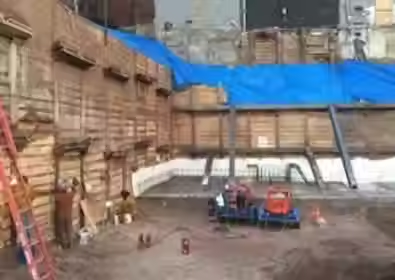
MKA, in Seattle, has been using DeepEX since 2011 to design deep excavations. Today we are focusing on two deep excavations they have designed in downtown Seattle, a 50ft deep excavation at Pike Place Market and an 80ft excavation at 9th and Lenora. Thanks to Zach Mendelsohn. P.E. and Michael Gottlier, for arranging site visits. Check out some nice images from both sites here.
Pike Place Market Expansion Project:
- 50ft excavation w/ 4-5 levels of tiebacks
- Underpinning of existing garage structure to the north
- Soils were medium to stiff silts and lean clay.
9th and Lenora (Residential) Project:
- 80ft excavation w/ up to 9 levels of tiebacks
- Internally braced north wall with 2’ diameter angled braces
- Soils were shallow fill (up to 15’) over a dense sand over glacial till
Both walls are performing well with pile deflections in the 0.25 to 0.5-inch range.
80 ft Soldier pile excavation in Seattle, designed by MKA with our DeepEX software
Zach Mendelsohn, P.E. (right) and Michael Gottlier (left)
Soldier pile excavation with tiebacks at Pike Street, Seattle, designed with DeepEX by MKA
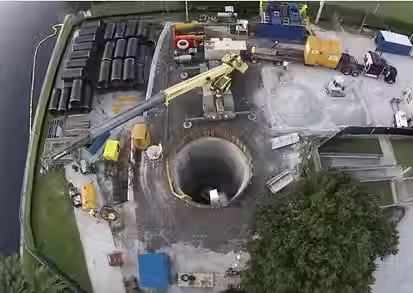
The site is just west of downtown Tampa, on the Hillsborough River. A new 48” diameter water main is to be installed by micro-tunneling under the river. On the west bank, there are alternating layers of sand, cherty limestone, and clay. Hayward Baker used DeepEx to design a combination earth retention and bottom plug system for the tunnel launch shaft that required excavating ~37-ft deep. The system was comprised of overlapping 6.5-ft diameter wet soil mix columns in a compression ring around the perimeter (unreinforced), and through a 6 to 8 ft thick targeted zone inside the ring (for the bottom plug).
DeepEX considers both installation tolerances and overalps to perform checks for the unreinforced soil mix section. The DeepEX stress checks consider both the tensile and compressive strength of the mix.
The mixing and excavation were successful. No dewatering was required. The tunneling has been completed.
Please contact Tanner Blackburn, Ph.D., P.E. at for more details (e-mail: jtblackburn@haywardbaker.com).
START WITH THE BASIC VERSION - POWER UP WITH ADDITIONAL MODULES!
DeepEX offers a series of options and additional modules that can greatly expand the software capabilities and cover your exact needs! Find out about the DeepEX software packages pricing and licensing.
8
Resources
CURIOUS TO LEARN MORE? DISCOVER OUR RESOURCES
DeepEX is the ultimate software program for design and analysis of Deep Excavations! Design any wall type and support system in the most efficient way!
-
Structural and Geotechnical Design
-
Modern Interactive Interface
-
Model Automatic Optimization
-
Export Reports and Sketches
-
Limit Equilibrium - Non-Linear - Finite Element Analysis
-
2D Design Sections - 3D Frame Analysis
Web Presentation
Get a Free online presentation! Learn about all software features and capabilities!
Purchase DeepEX
Get the most powerful shoring design software! Customize your version!
Software
Review our software programs for geotechnical engineers and contractors!
3
Experties
DISCOVER MORE ABOUT DEEPEX
Designing any Excavation Project?