
Surcharges in DeepEX
- Jan 26, 2024
- 2 min read
Updated: Mar 21, 2024
Surcharges in DeepEX
DeepEX enables the user to use a number of different surcharge types. Some of these surcharges are common with NONLINEAR, however, most surcharge types are not currently included in the Nonlinear Engine. The Table below lists the available types of surcharges.
Table: Available surcharge types
Surcharge Type | Permanent/Temporary (P/T) | Exists in Nonlinear Engine | Exists in Conventional Analysis | Conventional Analysis Comments |
Surface Line load | P & T | No | Yes | Theory of elasticity. Can include both Horizontal and Vertical components. |
Line load | P & T | No | Yes | Same as above |
Wall Line Load | P & T | No | Yes | Same as above |
Surface Strip Surcharge | P & T | Yes | Yes | Same as above |
Wall strip Surcharge | P & T | Yes | Yes | Same as above |
Arbitrary Strip Surcharge | P & T | No | Yes | Theory of elasticity. Vertical Direction only. |
Footing (3D) | P | No | Yes | Theory of elasticity. Vertical Direction only. |
Building (3D) | P | No | Yes | Theory of elasticity. Vertical Direction only. |
3D Point Load | P & T | No | Yes | Theory of elasticity. Vertical Direction only. |
Vehicle (3D) | T | No | Yes | Theory of elasticity. Vertical Direction only. |
Area Load (3D) | P & T | No | Yes | Theory of elasticity. Vertical Direction only. |
Moment/Rotation | - | Yes | No | - |
When EC7 (or DM08) is utilized, the following items are worth noting:
In the NONLINEAR module: In the default option the program does not use the Default Nonlinear Engine for determining surcharge actions, but calculates all surcharges according to the conventional methods. If the Nonlinear Simplified Load Options are enabled, then all conventional loads are ignored. Only loads that match the Nonlinear engine criteria are utilized.
Unfavorable Permanent loads are multiplied by F_LP while favorable permanent loads are multiplied by 1.0.
Unfavorable Temporary loads are multiplied by F_LV while favorable temporary loads are multiplied by 0.
The software offers great versatility for calculating surcharge loads on a wall. Surcharges that are directly on the wall are always added directly to the wall. In the default setting, external loads that are not directly located on the wall are always calculated using theory of elasticity equations. Most formulas used are truly applicable for certain cases where ground is flat or the load is within an infinite elastic mass. However, the formulas provide reasonable approximations to otherwise extremely complicated elastic solutions. When Poison's ratio is used the software finds and uses the applicable Poisson ratio of v at each elevation.

Figure: Simplified Nonlinear load options and Elasticity surcharge options

DeepEX Features
All software features and capabilities! Review all available design methods and analysis standards!

DeepEX Upgrades
We continue our research and we introduce new unique features that extend the software capabilities!

Training
Get professional training on DeepEX through videos, examples, webinars and online software presentations!
Line Load Surcharges
Line loads are defined with two components: a) a vertical Py, and b) a horizontal Px. It is important to note that the many of the equations listed below are, only by themselves, applicable for a load in an infinite soil mass. For this reason, the software multiplies the obtained surcharge by a factor m that accounts for wall rigidity. The software assumes a default value m=2 that accounts for full surcharge “reflection” from a rigid behavior. However, a value m=1.5 might be a reasonably less conservative assumption that can account for limited wall displacement.
For line loads that are located on the surface (or the vertical component strip loads, since strip loads are found by integrating with line load calculations), equations that include full wall rigidity can be included. This behavior can be selected from the Loads/Supports tab as Figure 4.2 illustrates. In this case, the calculated loads are not multiplied by the m factor.
For vertical line loads on the surface: When the Use Equations with Wall Rigidity option is not selected, the software uses the Boussinesq equation listed in Poulos and Davis, 1974, Equation 2.7a

For a vertical surface line load, when the Use Equations with Wall Rigidity option is selected, the software uses the Boussinesq equation as modified by experiment for ridig walls (Terzaghi, 1954).
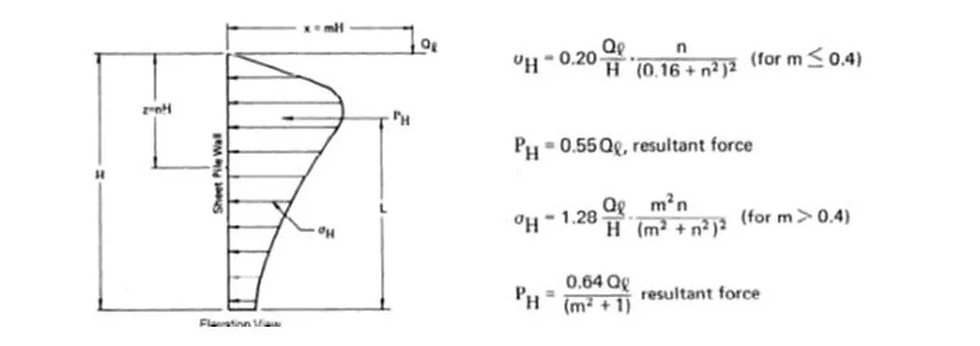
For vertical line loads within the soil mass: The software uses the Melan’s equation listed in Poulos and Davis, 1974, Equation 2.10b pg. 27

For the horizontal component of a surface line load: The software uses the integrated Cerruti problem from Poulos and Davis Equation 2.9b

For the horizontal component of a line load within the soil mass: The software uses Melan’s problem Equation 2.11b pg. 27, from Poulos & Davis

Strip Surcharges
Strip loads in DeepEX can be defined with linearly varying magnitudes in both vertical and horizontal directions. Hence, complicated surcharge patterns can be simulated. Surcharge pressures are calculated by dividing the strip load into increments where an equivalent line load is considered. Then the line load solutions are employed and numerically integrated to give the total surcharge at the desired elevation. The software subdivides each strip load into 50 increments where it performs the integration of both horizontal and vertical loads. On surface loads, the vertical load is calculated from integration along x and not along the surface line.
3D surcharge loads
The software offers the possibility to include other 3-dimensional surcharges. In essence, all these loads are extensions/integrations of the 3D point vertical load solution.
For 3D footings, the surcharge on the wall can be calculated in two ways:
By integrating the footing bearing pressure over smaller segments on the footing footprint. In this case the footing is subdivided into a number of segments and the surcharge calculations are slightly more time consuming.
By assuming that the footing load acts as a 3D point load at the footing center coordinates.
For loads that are located on the surface: The software program uses the Boussinesq equation. Results from the following equations are multiplied by the elastic load adjustment factor m as previously described.

The radial stress increment is then calculated as:

The hoop stress is defined as:

With the angles defined as:

Then, the horizontal component surcharge is:

For vertical point loads within the soil mass: The software uses the Mindlin solution as outlined by Poulos and Davis, 1974 equations 2.4.a, and 2.4.g


Wish to Learn about all Implemented Methods?
Book a FREE online presentation now!

DeepEX - Shoring Design Software
DeepEX is the ultimate software program for design and analysis of Deep Excavations! Design any wall type and support system in the most efficient way!
|
|
|
|
|
|

DeepEx Demo
Structural and Geotechnical design of Deep Excavations.
Try the Full version for free and see how you can design and optimize any deep excavation model in the most efficient way!
Starting at
$ 3750

Web Presentation
Get a Free online presentation! Learn about all software features and capabilities!

Purchase DeepEX
Get the most powerful shoring design software! Customize your version!

Software
Review our software programs for geotechnical engineers and contractors!


